


Galgame汉化中的逆向(八)_哈希算法分析_以krkrz_hxv4为例
之前我几篇hxv4还原计划,由于很多人对于hxv4不是很了解,故也将此贴发到这里和绯月, 用于科普。【游戏解包】DC5PH_D.C.5PlusHappiness_初音岛5 (HXV4还原计划1) https://www.kungal.com/topic/1939 【游戏解包】DC5SH_D.C.5 Sweet Happiness_初音岛5FD(HXV4还原计划2)https://www.kungal.com/topic/2767 【游戏解包】DC1RE_D.C. Re:tune_初音岛1RE(HXV4还原计划3) https://www.kungal.com/topic/2823
这几年ai迅速发展,使得逆向分析门槛大幅下降。若依赖ai反而会觉得缺少乐趣,亦或是和ai扯皮半天,ai还睁眼说瞎话,你纠正错误到面红耳赤,它反手给你甩个“you reached rate limit”强行结束。逆向作为茶余饭后之娱乐活动,就和我们喜欢手动挡一样,完全由自己掌控的心流令人欲罢不能。本文将不依赖ai, 依旧以传统的逆向方法和技巧来呈现。
时隔三年再次发帖,提前祝大家新年快乐~
by devseed
0x0 background
近些年,wamsoft魔改的krkrz引入了hxv4解密方案,最大的区别是封包只存储文件哈希值,不存储文件名。游戏脚本(通常为*.scn)内资源文件以原始文件名存储,引擎运行时计算得到哈希值,从而找到封包内对应文件。由于哈希函数不可逆,这使得要想得到文件名变得非常麻烦(要么你得跑一边游戏所有分支剧情dump,或者干脆不要文件名了)。
目前主要有两种方案,运行时dump(krkrdump)、扫描对应的脚本构建字符串碰撞从而得到哈希值和文件名的映射(KrkrExtractForCxdecV2+krkr_hxv4_dumphash)。本文将以dc5ph为例分析hxv4的哈希函数,以及如何还原对应的算法和数据结构。
0x1 krkrz、hxv4
直接分析hxv4则是非常困难的,可以通过原版krkrz了解引擎大概加载流程,再针对性的进行寻找,原版Stream如下:
tTVPPlugin -> TVPCreateIStream -> _TVPCreateStream -> tTVPArchive::CreateStream -> TVPStorageMediaManager.Open -> tTVPXP3Archive::CreateStreamByIndex -> Read关于hxv4,可以参考hxcrypt。Hxv4entry内容是加密的,先解密这个entry,之后得到filter key在用旧版cxdec方法解密各个文件entry。如下:
// decrypt hxv4 index
Xp3Stream::TryOpen -> HxCrypt::ReadIndex -> HxChachaDecryptor::Decrypt

// decrypt file content
HxFilter::Decrypt -> HxFilterSpan::DecryptHeader解密相关参数示例如下,获取方式可以用我写的firda脚本krkr_hxv4_dumpkey。
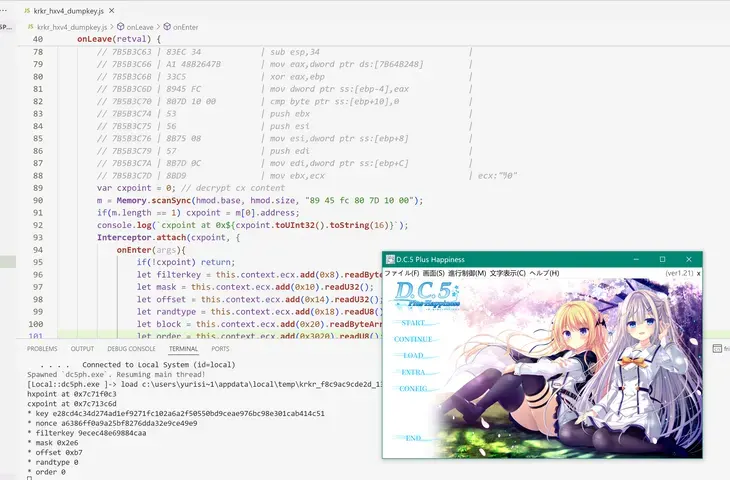
control_block.bin // 4096 bytes
hxpoint at 0x5b18f0c3
cxpoint at 0x5b183c6d
* key : b338a06fc12ba33610e7e4428c8389ca0342b418ae6a77e5287e3607e41fe65b
* nonce : ec668fc7eff5f388612eb56f1e6d4d6f
* filterkey : 4eef61df5f2e1771
* mask : 0x273
* offset : 0x178
* randtype : 1
* order : 04 00 02 03 06 01 07 05 04 05 00 01 03 02 00 02 01
* PrologOrder (garbro) : 0, 2, 1
* OddBranchOrder (garbro) : 3, 4, 0, 1, 2, 5
* EvenBranchOrder (garbro) : 2, 6, 3, 1, 0, 4, 5, 7
0x2 program flow
分析的切入点结合krkrz源码是虚函数的RTTI,找到关键函数v2link, tTVPXP3ArchiveStream。找到此函数,即可调用read函数将其文件动态dump出来。
.rdata:00728520 ; class tTVPXP3ArchiveStream: TJS::tTJSBinaryStream;   (#classinformer)
.rdata:00728520                 dd offset ??_R4tTVPXP3ArchiveStream@@6B@ ; const tTVPXP3ArchiveStream::`RTTI Complete Object Locator'
.rdata:00728524 ; const tTVPXP3ArchiveStream::`vftable'
.rdata:00728524 ??_7tTVPXP3ArchiveStream@@6B@ dd offset tTVPXP3ArchiveStream__Seek_437230
.rdata:00728524                                         ; DATA XREF: sub_436D90+41↑o
.rdata:00728524                                         ; sub_436E90+2A↑o
.rdata:00728528                 dd offset tTVPXP3ArchiveStream__Read_4372E0
.rdata:0072852C                 dd offset sub_402CD0
.rdata:00728530                 dd offset sub_4768F0
.rdata:00728534                 dd offset tTVPXP3ArchiveStream__GetSize_437480
.rdata:00728538 dd offset tTVPXP3ArchiveStream__deconstruct_436E60如果没有RTTI,则可以通过函数特征码定位(一般来说编译器变化不大的情况下,生成对应函数的代码差不多,所以可以自己编译一下,看看对应函数代码什么样)。TVPCreateStream函数和对应的代码如下。这个函数找到后继续跟TVPStorageMediaManager::Open_40CFD0函数顺藤摸瓜找到hxv4相关函数。不同于传统的krkrz filter解密函数,hxv4通过StorageMediaManager对stream接管很早。
.text:0040EDB0                   ; =============== S U B R O U T I N E =======================================
.text:0040EDB0
.text:0040EDB0                   ; signature: 55 8b ec 6a ff 68 ? ? ? ? 64 a1 ? ? ? ? 50 83 ec 5c 53 56 57 a1 ? ? ? ? 33 c5 50 8d 45 f4 64 a3 ? ? ? ? 89 65 f0 89 4d ec c7 45 ? ? ? ? ? e8 ? ? ? ? 8b 4d f4 64 89 0d ? ? ? ? 59 5f 5e 5b 8b e5 5d c3
.text:0040EDB0                   ; void *__fastcall TVPCreateStream_40EDB0(void *name, uint32_t flags)
.text:0040EDB0                   _TVPCreateStream_40EDB0 proc near       ; CODE XREF: TVPCreateStream_40F040+35↓p
.text:0040EDB0
.text:0040EDB0                   ; __unwind { // SEH_40EDB0
.text:0040EDB0 55                                push    ebp
.text:0040EDB1 8B EC                             mov     ebp, esp
.text:0040EDB3 6A FF                             push    0FFFFFFFFh
.text:0040EDB5 68 C8 9F 69 00                    push    offset SEH_40EDB0
.text:0040EDBA 64 A1 00 00 00 00                 mov     eax, large fs:0
.text:0040EDC0 50                                push    eax
.text:0040EDC1 83 EC 24                          sub     esp, 24h
.text:0040EDC4 53                                push    ebx
.text:0040EDC5 56                                push    esi
.text:0040EDC6 57                                push    edi
.text:0040EDC7 A1 50 F9 76 00                    mov     eax, ___security_cookie
.text:0040EDCC 33 C5                             xor     eax, ebp
.text:0040EDCE 50                                push    eax
.text:0040EDCF 8D 45 F4                          lea     eax, [ebp+var_C]
.text:0040EDD2 64 A3 00 00 00 00                 mov     large fs:0, eax
.text:0040EDD8 89 65 F0                          mov     [ebp+var_10], esp
.text:0040EDDB 8B DA                             mov     ebx, edx
.text:0040EDDD 89 5D DC                          mov     [ebp+flags_alter1], ebx
.text:0040EDE0 8B F9                             mov     edi, ecx
.text:0040EDE2 C7 45 D4 84 64 78                 mov     [ebp+var_2C], offset stru_786484
.text:0040EDE2 00
.text:0040EDE9 68 84 64 78 00                    push    offset stru_786484 ; lpCriticalSection
.text:0040EDEE FF 15 24 03 6C 00                 call    ds:EnterCriticalSection
.text:0040EDF4                   ;   try {
.text:0040EDF4 C7 45 FC 00 00 00                 mov     [ebp+var_4], 0
.text:0040EDF4 00
.text:0040EDFB C7 45 EC 00 00 00 mov [ebp+name_alter1], 0调试后可知hxv4的dll藏在exe资源文件中,去hookLoadlibraryW后可知他会在C盘生成类似于krkr_xxx/yyy.dll,hxv4相关的文件解密还有哈希函数都在里面,切入点如下:
.rdata:1008199C                   ; struct struct DefaultCompoundHasher<PathNameHashTrait>: struct CompoundStringHasher;   (#classinformer)
.rdata:1008199C F4 6B 09 10                       dd offset ??_R4?$DefaultCompoundHasher@UPathNameHashTrait@@@@6B@ ; const DefaultCompoundHasher<PathNameHashTrait>::`RTTI Complete Object Locator'
.rdata:100819A0                   ; const DefaultCompoundHasher<struct PathNameHashTrait>::`vftable'
.rdata:100819A0 C0 67 01 10       ??_7?$DefaultCompoundHasher@UPathNameHashTrait@@@@6B@ dd offset au_re_j__free_0_12
.rdata:100819A0                                                           ; DATA XREF: sub_10016680+2B↑o
.rdata:100819A0                                                           ; deconstructor
.rdata:100819A4 F0 69 01 10                       dd offset DirHashCompute_100169F0
.rdata:100819A8
.rdata:100819A8                   ; struct struct DefaultCompoundHasher<FileNameHashTrait>: struct CompoundStringHasher;   (#classinformer)
.rdata:100819A8 40 6C 09 10                       dd offset ??_R4?$DefaultCompoundHasher@UFileNameHashTrait@@@@6B@ ; const DefaultCompoundHasher<FileNameHashTrait>::`RTTI Complete Object Locator'
.rdata:100819AC                   ; const DefaultCompoundHasher<struct FileNameHashTrait>::`vftable'
.rdata:100819AC 80 67 01 10       ??_7?$DefaultCompoundHasher@UFileNameHashTrait@@@@6B@ dd offset au_re_j__free_0_11
.rdata:100819AC                                                           ; DATA XREF: sub_10016580+2B↑o
.rdata:100819B0 00 69 01 10                       dd offset FileHashCompute_10016900

00000000 struct IStringHasher_VptrTable // sizeof=0x8
00000000 {
00000000     void *Destruct;
00000004     void *Calculate;
00000008 };

00000000 struct IStringHasher // sizeof=0xC
00000000 {
00000000     IStringHasher_VptrTable *VptrTable;
00000004     uint8_t *salt;
00000008     int saltsize;
0000000C };
从切入点顺藤摸瓜,可以归纳出下列数据结构和行为逻辑:
typedef  tjs_int(__fastcall *FuncHxv4CalcHash)(Hxv4CompoundHasher* _this, void* _edx,
    OUT tTJSVariant* hash, const tTJSString* str, const tTJSString* seed);

typedef struct Hxv4CompoundHasher
{
    struct
    {
        void* destruct;
        FuncHxv4CalcHash calc;
    } *vftable; // offset 0
    tjs_uint8* salt;  // offset 0x4
    tjs_int saltsize; // offset 0x8
} Hxv4CompoundHasher;

typedef struct Hxv4DirHasher
{
    Hxv4CompoundHasher base;
    tjs_uint8 saltdata[0x10];
} Hxv4DirHasher;

typedef struct Hxv4FileHasher
{
    Hxv4CompoundHasher base;
    tjs_uint8 saltdata[0x20];
} Hxv4FileHasher;

typedef struct Hxv4CompoundStorageMedia
{
    void* vftable;
    int nref;
    uint32_t reserve1;
    tTJSString prefix;
    tTJSString seed; //offset 0x10
    CRITICAL_SECTION critical_section;
    uint8_t reserve2[0x20];
    tTJSString* start;
    tTJSString* pos;
    tTJSString* end;
    Hxv4DirHasher* dirhasher; // offset 0x58
    Hxv4FileHasher* filehasher;
} Hxv4CompoundStorageMedia;

// hook from here
unsigned int __cdecl CreateCompoundStorageMedia_100059D0(
        CompoundStorageMedia **retTVPStorageMedia,
        int tjsVarPrefix,
        int argc,
        int *argv)
{
    ...
    if ( argc > 1 ) CompoundStorageMedia::Init_1000A3D0(*retTVPStorageMedia, 0, *argv, argv[1]);
    ...
    *retTVPStorageMedia = v10;
    TVPRegisterStorageMedia_100068C0(v10); // in exe it will tTVPStorageMediaManager::Open
    ...
}

int __thiscall CompoundStorageMedia::Init_1000A3D0(CompoundStorageMedia *this, int a2, void *seed_variant, size_t Size)
{
    ...
  this->PathNameHasher = (IStringHasher *)PathNameHasher::Init_10016890(Size);
  this->FileNameHasher = (IStringHasher *)FileHasher::Init_10016820(Size);
    ...
}至此我们已经找到了哈希函数了,可以动态附加到游戏程序里,直接调用Hxv4CompoundHasher::vftable->calc来计算任意字符串,详见krkr_hxv4_dumphash。
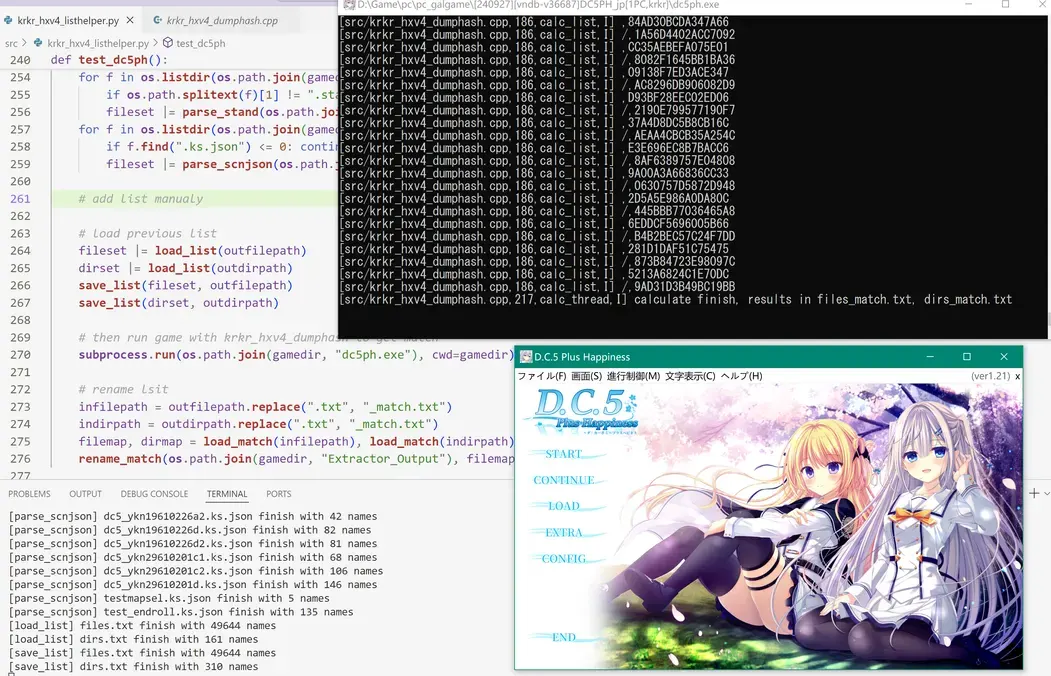
0x3 hash function
动态dump hash后,更进一步,我们要怎么分析算法逻辑,并且能够静态复现呢?最笨的方法是直接把相关逻辑的C伪代码或者汇编代码搬出来,逐个模拟实现(汇编可用unicorn模拟)。但是这种方法费时费力,一个哈希函数动辄上千行,还特别容易出错。所以去年分析到动态调用这一步就没再继续,最近看了看发现可以从特征进行分析,从而得以继续。
站在开发者的角度想,大部分游戏不会自己研制一套全新的哈希算法,大多数是用现有的方法,或者在现有的方法上改改参数或流程。因此我们还原算法的主要目标,是寻找当前算法是哪个原有算法的改版。那么哈希算法如何进行呢?通常是下面几个步骤:
init(key, salt) -> update(buf, lastvalue) -> final(outsize)
还原哈希算法,函数的输入输出还有函数内相关常数需要重点关注。本游戏有两种哈希算法,计算文件名的hash、计算文件夹的hash。
file hash
计算文件哈希算法如下,tTJSString使得此函数变得很乱, 移除掉后可以很清晰的看到计算哈希的流程。输入为文本unicode编码,输出为32字节。之前动态调用计算得到一组值为!scnlist.txt,C1F625E3A4BB508E082A52A8B032F4B3D2F34FF7FB3A30502574717DE6579126。
filehash_init_1000E070 -> filehash_update_100159F0 -> filehash_final32_10016B00
int __userpurge FileHashCompute_10016900@<eax>(
        IStringHasher *this@<ecx>,
        void *hashValueRet,
        tTJSString_S *rawstr,
        tTJSString_S *seed)
{
  size_t (__stdcall *v4)(tTJSString_S *); // eax
  int (__stdcall *v5)(tTJSString_S *); // eax
  uint8_t *raw_cstr; // eax
  int (__stdcall *v7)(tTJSString_S *); // eax
  int seed_len; // edi
  int (__stdcall *v9)(tTJSString_S *); // eax
  uint8_t *seed_cstr; // eax
  size_t v12; // [esp-8h] [ebp-94h]
  filehash_ctx ctx; // [esp+Ch] [ebp-80h] BYREF

  filehash_init_1000E070(&ctx, 0x20u, this->salt, this->saltsize);
  v4 = (size_t (__stdcall *)(tTJSString_S *))tTJSString::length_100AD158;
  if ( !tTJSString::length_100AD158 )
  {
    v4 = (size_t (__stdcall *)(tTJSString_S *))findfunc_10016420((void (__stdcall *)(_DWORD))aTjsIntTtjsstri);
    tTJSString::length_100AD158 = (int)v4;
  }
  v4(rawstr);
  v5 = (int (__stdcall *)(tTJSString_S *))TJSString::c_str_100AD0F4;
  if ( !TJSString::c_str_100AD0F4 )
  {
    v5 = (int (__stdcall *)(tTJSString_S *))findfunc_10016420((void (__stdcall *)(_DWORD))aConstTjsCharTt);
    TJSString::c_str_100AD0F4 = (int)v5;
  }
  raw_cstr = (uint8_t *)v5(rawstr);
  filehash_update_100159F0(&ctx, raw_cstr, v12); // v12=2*rawstr_len
  if ( seed )
  {
    v7 = (int (__stdcall *)(tTJSString_S *))tTJSString::length_100AD158;
    if ( !tTJSString::length_100AD158 )
    {
      v7 = (int (__stdcall *)(tTJSString_S *))findfunc_10016420((void (__stdcall *)(_DWORD))aTjsIntTtjsstri);
      tTJSString::length_100AD158 = (int)v7;
    }
    seed_len = v7(seed);
    v9 = (int (__stdcall *)(tTJSString_S *))TJSString::c_str_100AD0F4;
    if ( !TJSString::c_str_100AD0F4 )
    {
      v9 = (int (__stdcall *)(tTJSString_S *))findfunc_10016420((void (__stdcall *)(_DWORD))aConstTjsCharTt);
      TJSString::c_str_100AD0F4 = (int)v9;
    }
    seed_cstr = (uint8_t *)v9(seed);
    filehash_update_100159F0(&ctx, seed_cstr, 2 * seed_len);
  }
  return filehash_final32_10016B00((int)&ctx, hashValueRet);// return 32, fill hashvalueret
}这里我们重点关注filehash_init_1000E070其中的init_filehash_ctx_10014140, 搜索立即数6A09E667h,可知这是sha256的table,其中blake2s算法也共用这个table。
filehash_ctx *__thiscall filehash_init_1000E070(filehash_ctx *pctx, size_t outlen, uint8_t *key, size_t keylen)
{
  size_t v5; // eax
  uint8_t tmp[32]; // [esp+Ch] [ebp-64h] BYREF
  uint8_t tmp2[64]; // [esp+2Ch] [ebp-44h] BYREF

  if ( outlen && outlen <= 0x20 && (key || !keylen) )
  {
    tmp[0] = outlen;
    memset(&tmp[9], 0, 23);
    *(_QWORD *)&tmp[1] = (unsigned __int8)keylen;
    *(_WORD *)&tmp[2] = 0x101;
    sub_10014260((uint8_t *)pctx, tmp);
    if ( key && keylen )
    {
      memset(tmp2, 0, sizeof(tmp2));
      v5 = 64;
      if ( keylen < 64 )
        v5 = keylen;
      memmove_0(tmp2, key, v5);
      filehash_update_100159F0(pctx, tmp2, 0x40u);
      memset(tmp2, 0, sizeof(tmp2));
    }
  }
  else
  {
    init_filehash_ctx_10014140(pctx);            // init filehash iv
  }
  return pctx;
}

.text:10014140 ; void *__thiscall init_filehash_ctx_10014140(filehash_ctx *pctx)
.text:10014140 ; sub_10010410+F5↑p ...
.text:10014140                 push    esi
.text:10014141                 mov     esi, ecx
.text:10014143                 push    40h ; '@'       ; Size
.text:10014145                 mov     dword ptr [esi], 6A09E667h
.text:1001414B                 mov     dword ptr [esi+4], 0BB67AE85h
.text:10014152                 mov     dword ptr [esi+8], 3C6EF372h
.text:10014159                 mov     dword ptr [esi+0Ch], 0A54FF53Ah
.text:10014160                 mov     dword ptr [esi+10h], 510E527Fh
.text:10014167                 mov     dword ptr [esi+14h], 9B05688Ch
.text:1001416E                 mov     dword ptr [esi+18h], 1F83D9ABh
.text:10014175                 mov     dword ptr [esi+1Ch], 5BE0CD19h
.text:1001417C                 lea     eax, [esi+30h]
.text:1001417F                 push    0               ; Val
.text:10014181                 mov     dword ptr [esi+20h], 0
.text:10014188                 mov     dword ptr [esi+24h], 0
.text:1001418F                 mov     dword ptr [esi+28h], 0
.text:10014196                 mov     dword ptr [esi+2Ch], 0
.text:1001419D                 push    eax             ; void *
.text:1001419E                 mov     eax, ds:off_10080BD4
.text:100141A3                 call    eax ; _memset
.text:100141A5                 add     esp, 0Ch
.text:100141A8                 mov     dword ptr [esi+70h], 0
.text:100141AF                 mov     dword ptr [esi+74h], 0
.text:100141B6                 mov     byte ptr [esi+78h], 0
.text:100141BA                 pop     esi
.text:100141BB                 retn
这时候就大胆假设小心求证了, 把blake2s的结构放进去看看能不能成立。经测试,这个和原版的blake2s结构体布局略有区别(input缓存和pos跑到下面了,并且多了个pos),如下结构体是能对上的。
struct filehash_ctx
{
  uint32_t h[8]; // chained state
  uint32_t t[2]; // total number of bytes
  size_t c; // pointer for b[]
  size_t outlen; // digest size
  uint8_t b[64]; // input buf
  uint32_t pos;
};

void *__thiscall filehash_update_100159F0(filehash_ctx *pctx, uint8_t *src)
{
  uint8_t *v2; // ebx
  size_t v4; // edi
  uint32_t pos; // ecx
  void *result; // eax
  uint32_t Srca; // [esp+10h] [ebp+8h]
  uint8_t *Srcb; // [esp+10h] [ebp+8h]
  size_t srcsize; // [esp+14h] [ebp+Ch]

  v2 = src;
  if ( src )
  {
    v4 = srcsize;
    if ( srcsize )
    {
      pos = pctx->pos;
      result = (void *)(64 - pos);
      Srca = 64 - pos;
      if ( srcsize > 64 - pos )
      {
        memmove_0(&pctx->b[pos], v2, 64 - pos);
        pctx->t[0] += 64;
        pctx->t[1] += pctx->t[0] < 0x40;
        result = (void *)filehash_compress_10012500(pctx, (int)pctx->b);
        v4 = srcsize - Srca;
        v2 += Srca;
        if ( srcsize - Srca > 0x40 )
        {
          Srcb = (uint8_t *)(((v4 - 65) >> 6) + 1);
          do
          {
            pctx->t[0] += 64;
            pctx->t[1] += pctx->t[0] < 0x40;
            result = (void *)filehash_compress_10012500(pctx, (int)v2);
            v2 += 64;
            v4 -= 64;
            --Srcb;
          }
          while ( Srcb );
        }
        pctx->pos = 0;
      }
      if ( v4 )
      {
        result = memmove_0(&pctx->b[pctx->pos], v2, v4);
        pctx->pos += v4;
      }
    }
  }
  return result;
}filehash_compress_10012500函数超级长, 不过大概流程和blake2s也能对上。G操作里面一大堆ROTR32。
int __thiscall filehash_compress_10012500(filehash_ctx *ctx, int last)
{
    ...
  v3 = 0;
  v4 = (unsigned __int8 *)(last + 2);
  do
  {
    *(&v663 + v3++) = *(v4 - 2) | (unsigned __int16)(*(v4 - 1) << 8) | ((*v4 | (unsigned __int16)(v4[1] << 8)) << 16);
    v4 += 4;
  }
  while ( v3 < 16 );
  v584 = *(_DWORD *)&ctx->h[12];
  v5 = *(_DWORD *)&ctx->h[16];
  v461 = __ROL4__((v5 + v663 + *(_DWORD *)ctx->h) ^ *(_DWORD *)&ctx->h[32] ^ 0x510E527F, 16);
  v6 = *(_DWORD *)&ctx->h[20];
  v624 = v5 + v663 + *(_DWORD *)ctx->h;
  v7 = v461 + 1779033703;
  v8 = __ROR4__(v5 ^ (v461 + 1779033703), 12);
  v462 = __ROR4__((v8 + v664 + v624) ^ v461, 8);
  v414 = v462 + v7;
  v343 = __ROR4__(v8 ^ (v462 + v7), 7);
  v529 = v6 + v665 + *(_DWORD *)&ctx->h[4];
  v625 = v8 + v664 + v624;
  v9 = __ROL4__(v529 ^ *(_DWORD *)&ctx->h[36] ^ 0x9B05688C, 16);
   ...
}
至此我们已经确信, file hash大概率是基于blake2s的算法了,先不去详细分析上面那个巨长函数,先尝试一下是不是标准blake2s。很幸运,这个游戏并没有大改,salt为空,原版函数再加上xp3hnp的seed(动态调试得到的)即可搞定。
from hashlib import blake2s
h = blake2s(digest_size=32)
h.update("!scnlist.txt".encode("utf-16le"))
h.update("xp3hnp".encode("utf-16le"))
print(h.hexdigest()) // c1f625e3a4bb508e082a52a8b032f4b3d2f34ff7fb3a30502574717de6579126
dir hash
分析文件夹哈希与文件哈希方法类似。输出8字节,动态计算的一组值为ED,FEF68C92D344F4F6。
int __userpurge DirHashCompute_100169F0@<eax>(
        IStringHasher *this@<ecx>,
        void *hashValueRet,
        tTJSString_S *rawstr,
        tTJSString_S *seed) // seed=xp3hnp
{
  int v4; // edi
  int v5; // esi
  int (__stdcall *v6)(tTJSString_S *); // eax
  int rawstr_len; // edi
  int (__stdcall *v8)(tTJSString_S *); // eax
  uint8_t *rawstr_cstr; // eax
  int (__stdcall *v10)(tTJSString_S *); // eax
  int seed_len; // edi
  int (__stdcall *v12)(tTJSString_S *); // eax
  uint8_t *seed_cstr; // eax
  unsigned int saltsize; // [esp-4h] [ebp-54h]
  uint8_t buf[80]; // [esp+0h] [ebp-50h] BYREF

  saltsize = this->saltsize;
  qmemcpy(buf, "uespemosmodnarodarenegylsetybdet", 32);// hash outsize is 32
  dirhash_init_100172E0(buf, this->salt, saltsize);
  v6 = (int (__stdcall *)(tTJSString_S *))tTJSString::length_100AD158;
  if ( !tTJSString::length_100AD158 )
  {
    v6 = (int (__stdcall *)(tTJSString_S *))findfunc_10016420((void (__stdcall *)(_DWORD))aTjsIntTtjsstri);
    tTJSString::length_100AD158 = (int)v6;
  }
  rawstr_len = ((int (__stdcall *)(tTJSString_S *, int, int))v6)(rawstr, v4, v5);
  v8 = (int (__stdcall *)(tTJSString_S *))TJSString::c_str_100AD0F4;
  if ( !TJSString::c_str_100AD0F4 )
  {
    v8 = (int (__stdcall *)(tTJSString_S *))findfunc_10016420((void (__stdcall *)(_DWORD))aConstTjsCharTt);
    TJSString::c_str_100AD0F4 = (int)v8;
  }
  rawstr_cstr = (uint8_t *)v8(rawstr);
  di rhash_update_10017480(buf, rawstr_cstr, 2 * rawstr_len);
  if ( seed )
  {
    v10 = (int (__stdcall *)(tTJSString_S *))tTJSString::length_100AD158;
    if ( !tTJSString::length_100AD158 )
    {
      v10 = (int (__stdcall *)(tTJSString_S *))findfunc_10016420((void (__stdcall *)(_DWORD))aTjsIntTtjsstri);
      tTJSString::length_100AD158 = (int)v10;
    }
    seed_len = v10(seed);
    v12 = (int (__stdcall *)(tTJSString_S *))TJSString::c_str_100AD0F4;
    if ( !TJSString::c_str_100AD0F4 )
    {
      v12 = (int (__stdcall *)(tTJSString_S *))findfunc_10016420((void (__stdcall *)(_DWORD))aConstTjsCharTt);
      TJSString::c_str_100AD0F4 = (int)v12;
    }
    seed_cstr = (uint8_t *)v12(seed);
    dirhash_update_10017480(buf, seed_cstr, 2 * seed_len);
  }
  return dirhash_final8_10016BD0(buf, hashValueRet);// fill hashValueRet, return hash size
}看到这行诡异的字符串uespemosmodnarodarenegylsetybdet,一开始以为是key,结果并不是,他是init的参数立即数内联过来了。搜索0x736F6D6570736575,第一条就是siphash。
.text:100169F0                 push    ebp
.text:100169F1                 mov     ebp, esp
.text:100169F3                 sub     esp, 50h
.text:100169F6                 push    dword ptr [ecx+8]
.text:100169F9                 mov     dword ptr [ebp+buf], 70736575h
.text:10016A00                 push    dword ptr [ecx+4]
.text:10016A03                 lea     ecx, [ebp+buf]
.text:10016A06                 mov     dword ptr [ebp+buf+4], 736F6D65h
.text:10016A0D                 mov     dword ptr [ebp+buf+8], 6E646F6Dh
.text:10016A14                 mov     dword ptr [ebp+buf+0Ch], 646F7261h
.text:10016A1B                 mov     dword ptr [ebp+buf+10h], 6E657261h
.text:10016A22                 mov     dword ptr [ebp+buf+14h], 6C796765h
.text:10016A29                 mov     dword ptr [ebp+buf+18h], 79746573h
.text:10016A30 mov dword ptr [ebp+buf+1Ch], 74656462h然后分析与上面类似,先写程序确定一下是不是常规的方法。经测试,文件夹哈希用了原版的siphash_2_4方案。
import siphash
h = siphash.SipHash_2_4(b"\x00" * 16)
h.update("ED".encode("utf-16le"))
h.update("xp3hnp".encode("utf-16le"))
print(h.hexdigest()) # FEF68C92D344F4F6
epilogue
好久没写逆向分析文章了,目前看除了我开源的krkr_hxv4_dumphash,没有公开的资料来具体分析这个臭名昭著的hxv4哈希函数,故写此文。写逆向游戏分析的文章不是想象中的那么容易,一写就是几个小时。因为分析游戏大多时间间隔很长,有时候卡住了往往要过几天才突然有灵感,有些关键地方可能突然想到了或者排查了半天刚好找到,整理并回顾这些过程也花了些时间。这些突破点往往不容易在文章里准确的表达,而且逆向本身也有很多很繁琐的流程,面面俱到都写进去反而使得文章冗长,整体流程不清晰。因此本文以分析哈希函数为主,其他部分仅写了关键流程和数据结构,略去了繁琐的调试过程,希望可以抛砖引玉,享受在逆向抽丝剥茧的乐趣中。
reference
krkrz KrkrExtractForCxdecV2 krkrdump hxcrypt krkr_hxv4_dumpkey krkr_hxv4_dumphash blake2s siphash










7 条回复